
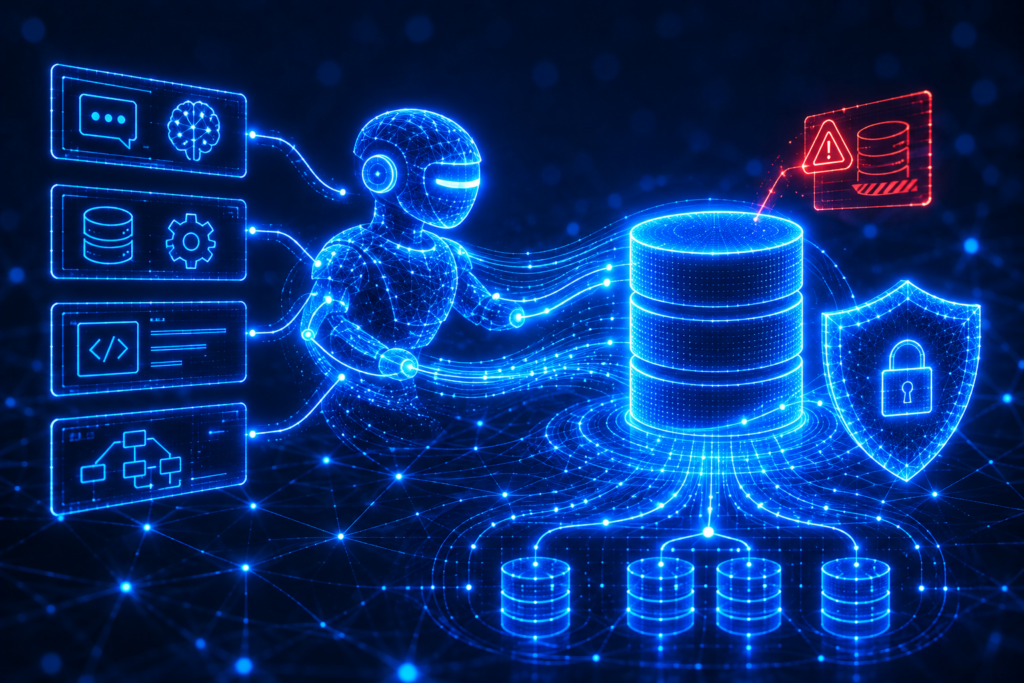
Agentic AI and Your Database: Why DBA Support Services Matter More Than Ever
As agentic AI systems gain autonomy to query, modify, and orchestrate data operations without human intervention, the stakes for database integrity have never been higher. DBA support services are no longer just about performance tuning and backup schedules—they’re now your front line of defense against AI agents that can inadvertently execute destructive queries, bypass security controls, or exfiltrate sensitive data at machine speed. When an LLM-powered agent misinterprets a prompt and issues a cascading DELETE command across production tables, traditional monitoring won’t catch it fast enough. The question isn’t whether your organization will adopt agentic AI, but whether your database administration strategy is prepared to govern autonomous systems that operate with database-level privileges. This convergence of AI capability and database access demands a fundamental rethinking of how we architect, monitor, and secure our data infrastructure.
How Agentic AI Changes the Database Risk Landscape
Agentic AI represents a fundamental shift from traditional AI systems. Unlike narrow AI models that simply respond to queries, agentic AI systems can plan, make decisions, and take autonomous actions to achieve defined goals. When these agents gain database access, they don’t just read data—they can execute queries, modify schemas, trigger stored procedures, and orchestrate complex data operations without human intervention at each step.
This autonomy introduces entirely new failure modes that traditional database administration wasn’t designed to address. An AI agent operating on flawed logic or incomplete context can execute thousands of DELETE or UPDATE statements in seconds, propagating errors across your data estate faster than any human operator could. Unlike a developer making a mistake in a single transaction, an agentic system can systematically apply that same mistake across every table it touches.
The security implications are equally concerning. LLM-powered agents are vulnerable to prompt injection attacks, where malicious input can cause the agent to execute unintended database operations. An agent with broad database permissions becomes a high-value target—compromising the agent’s logic or training data could grant attackers an automated tool for data exfiltration or destruction.
Furthermore, these agents often operate across multiple databases and platforms simultaneously, creating cascading risk scenarios. A single misconfigured agent with access to both your operational PostgreSQL instances and your analytical data warehouses could corrupt or leak data across your entire infrastructure before traditional monitoring systems even register an anomaly. The speed and scale at which agentic AI operates transforms database risk from a tactical concern into a strategic vulnerability.
Why Traditional Database Administration Isn’t Enough
Conventional database administration was designed for human-paced operations—scheduled backups, manual query reviews, and access controls that assume humans will pause before executing commands. Agentic AI shatters these assumptions. When AI agents interact with your databases, they operate at machine speed, executing hundreds or thousands of queries per second, adapting their approaches based on LLM reasoning, and making autonomous decisions without the natural hesitation that gives human DBAs time to catch errors.
This velocity fundamentally changes risk profiles. A misconfigured AI agent can cascade through your production environment in seconds, not hours. Traditional monitoring tools designed to flag suspicious activity after the fact become insufficient when damage occurs faster than alerts can propagate. Point-in-time recovery strategies that assume deliberate human actions must now account for algorithmic decisions that can alter millions of records before anyone notices.
Modern managed database services address these challenges by implementing AI-aware safeguards: real-time query pattern analysis that distinguishes between legitimate AI behavior and anomalous access, fine-grained permission boundaries that limit blast radius even when AI credentials are compromised, and automated rollback triggers that can halt cascading changes mid-execution. These aren’t simply faster versions of traditional DBA practices—they’re architecturally different approaches built for autonomous agents.
Equally critical is database security hardening that anticipates AI-specific attack vectors. Standard role-based access control assumes users request predictable data sets. AI agents may legitimately need broad read access for training but must be prevented from indiscriminate writes. Enhanced DBA support services implement context-aware permissions that evaluate not just who is accessing data, but how, when, and at what velocity—essential distinctions when securing AI-driven database interactions.
Best Practices for Securing AI-Driven Database Access
Protecting your databases from autonomous AI agents requires a fundamental shift in how you implement access controls and monitoring. DBA support services now must establish granular, role-based permissions that limit what each AI agent can access and modify. Rather than granting broad database permissions, DBAs should create specific service accounts for each agentic AI application, restricting access to only the schemas, tables, and operations that agent legitimately requires. This principle of least privilege becomes critical when autonomous systems can execute thousands of queries without human review.
Comprehensive audit logging represents your second line of defense. Modern DBA support teams implement detailed tracking of every AI-initiated transaction, capturing not just what data was accessed but the context of each operation. These audit trails enable rapid forensic analysis when anomalies occur and provide the evidence needed to refine AI agent permissions over time. Many organizations now require DBAs to configure real-time alerting on specific patterns—such as bulk deletes, schema modifications, or unusual query volumes—that could indicate an AI agent operating outside expected parameters.
Data loss prevention strategies must extend beyond traditional backup schedules. DBAs should implement point-in-time recovery capabilities, immutable backup snapshots, and automated backup, recovery, and resilience protocols specifically designed to restore databases rapidly if an AI agent triggers catastrophic data changes. Continuous monitoring of database performance metrics, query patterns, and resource consumption allows DBAs to detect when AI agents begin exhibiting abnormal behavior before that behavior escalates into a security incident or data loss event. This proactive stance transforms database administration from reactive troubleshooting into predictive risk management.
Partnering with Expert DBA Support Services for AI-Ready Infrastructure
The stakes have never been higher. Agentic AI systems demand access to production data, execute queries autonomously, and make decisions that can cascade across your entire infrastructure in milliseconds. Without specialized DBA support services that understand both traditional database administration and emerging AI security patterns, organizations face an impossible choice: limit AI capabilities or accept unacceptable risk.
The solution isn’t choosing between innovation and safety—it’s partnering with database experts who architect both. Solvaria’s Managed Database Services (MMT/365) combine decades of database administration expertise with forward-looking AI governance frameworks. Our teams implement the query governors, audit trails, and segmentation strategies your LLM agents need while maintaining the performance and availability your business demands.
Don’t wait for an AI-driven incident to expose gaps in your database security posture. Start with a comprehensive Database Assessment (MMT/VantagePoint) that evaluates your current environment against AI access requirements, identifies vulnerabilities before they’re exploited, and creates a roadmap for AI-ready database infrastructure.
Your next AI breakthrough shouldn’t come with existential database risk. Contact Solvaria today to learn how expert DBA support services can transform your database layer into a secure, governed foundation for agentic AI innovation.
Frequently Asked Questions
Why do I need specialized DBA support services for agentic AI systems?
Agentic AI systems operate at machine speed, executing thousands of autonomous database queries without human oversight. Traditional database administration wasn’t designed for this velocity—specialized DBA support services implement AI-aware safeguards like real-time query pattern analysis, context-aware permissions, and automated rollback triggers that prevent AI agents from causing catastrophic data loss or security breaches before damage occurs.
What security risks do LLM-powered AI agents pose to databases?
LLM-powered agents are vulnerable to prompt injection attacks that can cause them to execute unintended database operations. When granted broad database permissions, compromised agents become automated tools for data exfiltration or destruction. They can systematically apply errors across multiple tables and databases simultaneously, propagating damage faster than traditional monitoring systems can detect anomalies.
How do modern DBA support services differ from traditional database administration?
Modern DBA support services implement AI-specific protections beyond traditional practices: granular service accounts for each AI agent with least-privilege access, comprehensive audit logging of AI-initiated transactions, real-time alerting on anomalous query patterns, and point-in-time recovery capabilities designed for rapid restoration after AI-driven incidents. These services combine database expertise with AI governance frameworks rather than simply optimizing backup schedules and performance tuning.